Enough. Foreign Intervention

TLDR. Seventy-five years and ten trillion dollars. U.S. foreign military intervention has been driven less by national security than by structural incentive misalignment. A military-industrial complex that profits from war, and a Congress that funds it. Iran is the central case study, an unbroken chain of avoidable choices from the 1953 CIA coup to Operation Epic Fury in 2026. Nine reforms could end this cycle. The first is the only one that matters: cut off the money.
Trump deepens U.S. combat operation in Iran
Defense Stocks Surge as Iran War and Security Supercycle Converge
Experts say U.S. lacked evidence of imminent Iran threat before strikes
If you’re wondering why we’re at war with Iran, you’re not alone. Most of us are either against it, or unsure why we’re there in the first place.
Sixty-one percent of Americans disapprove of how Trump has handled Iran. Fifty-nine percent say striking Iran was the wrong decision. (Pew Research, March 25, 2026, 3,524 U.S. adults.) I mean… did anyone call you to ask how you feel about the war?
A bit of history will help us here.
In 1953, the CIA overthrew Iran’s Prime Minister Mohammad Mosaddegh and installed the Shah. Mosaddegh came to power through Iran’s constitutional democratic process. He was nominated by the Majles and confirmed as Prime Minister in 1951. The operation was codenamed TPAJAX by the CIA and Operation Boot by Britain’s MI6. It is known publicly as Operation Ajax.
The public rationale was Cold War containment. The argument went that Mosaddegh was weak, unstable, and increasingly dependent on the Tudeh Party (Iran’s communists) to hold his coalition together. If Iran tipped communist, the USSR would gain warm-water access, control over Persian Gulf oil flows, and a strategic foothold bordering the Middle East. Secretary of State John Foster Dulles and CIA Director Allen Dulles sold it to Eisenhower as a preemptive strike against a domino fall.
The real rationale: Oil.
In 1951, Mosaddegh nationalized the Anglo-Iranian Oil Company (now BP), which had been paying Iran a pittance for decades while extracting enormous profits. Britain lost its single most valuable overseas asset overnight and organized a global boycott of Iranian oil that crippled the economy. The Truman administration refused to help Britain overthrow Mosaddegh. When Eisenhower took office in 1953, the British repackaged the pitch from “we want our oil back” to “Iran is going communist,” and the new administration bit. After the coup, the nationalized oil industry was restructured so American companies took 40% of what had been a 100% British operation.

The Shah we installed was permanently compromised because everyone in Iran knew he’d been put on the throne by the CIA and Britain. So he ruled through repression instead of consent.
With the help of the CIA and Israel’s Mossad, he created SAVAK, the secret police. A brutal regime that tortured and publicly executed Iranian citizens. In a February 19, 1979 article titled “SAVAK: Like the CIA,” Time called it Iran’s “long been Iran’s most hated and feared institution.”
His 1963 White Revolution (land reform, women’s suffrage, secularization) alienated the religious population, and rural Iranians who were economically displaced by the land reforms.
Mass protests began in 1977, and the Shah fled in 1979. The new regime defined itself in opposition to America. Death To America.
You may remember the hostage crisis that followed. If not, Ben Affleck made a movie about it called Argo. (Better than Gigli for sure.)
The hostage crisis occurred because we gave the Shah asylum when he fled the country.
Then in 1980, we backed Saddam Hussein when he invaded Iran. While we didn’t have boots on the ground, we provided strategic and financial support, and looked the other way as Saddam used chemical weapons. When Iraq gassed Halabja in March 1988, killing roughly 5,000 Kurdish civilians in a single day, the U.S. Defense Intelligence Agency initially blamed Iran. Historian Joost Hiltermann calls that disinformation “another green light” for Saddam’s broader Anfal campaign. Reagan blocked Senate sanctions efforts.
This conflict radicalized Iran’s Revolutionary Guard, created the martyrdom culture, and reinforced Iran’s paranoia.
In the 1990s we started imposing sanctions on Iran, to hurt their economy, and further isolate them.
On January 29, 2002, about four and a half months after 9/11, President Bush lumped Iran together with Iraq and North Korea in his “axis of evil” speech.
What most of us don’t know (I didn’t until I began research for this article), is that in spite of all we had done to Iran, beginning in the late 90s, they wanted to become our allies.
Mohammad Khatami had been elected Iranian president in 1997 on an explicitly reformist platform. He called for a “Dialogue Among Civilizations.” In the months after 9/11, Iran did more to help the U.S. than most NATO allies.
Iran and the Taliban were enemies. The Taliban were Sunni extremists who had massacred Shia Hazaras. In 1998 they killed eight Iranian diplomats and an Iranian journalist at Mazar-i-Sharif, with two more diplomats also confirmed dead, bringing the Iranian death toll to as many as eleven. Iran had backed the Northern Alliance for years. When the U.S. went to war against the Taliban, Iran provided intelligence on Taliban positions, allowed U.S. search-and-rescue operations in Iranian territory, offered to let downed American pilots come through Iran, and shared targeting data. Iran’s Quds Force (the same organization we later demonized) actively coordinated with American forces. At the December 2001 Bonn Conference, Iran’s Mohammad Javad Zarif personally persuaded Northern Alliance leader Yunus Qanooni to accept the framework that became the Karzai government. James Dobbins, the U.S. envoy, has confirmed all of this on the record.
In 2003, right before the Iraq invasion, Iran sent a comprehensive diplomatic proposal to Washington through the Swiss embassy. The fax went via Swiss Ambassador Tim Guldimann on May 4, 2003. (Switzerland handles U.S.-Iran diplomacy since we have no direct relations.) The proposal, which became known as the “Grand Bargain,” offered to:
End Iranian support for Hamas and Palestinian Islamic Jihad
Convert Hezbollah into a purely political organization
Open Iran’s nuclear program to full transparency
Recognize Israel (implicitly, via accepting the Arab League’s 2002 peace initiative)
Cooperate against al-Qaeda
In exchange, Iran wanted security guarantees, lifting of sanctions, and normalization of relations.
The Bush administration did not pursue it, and the State Department formally rebuked the Swiss Foreign Ministry over Guldimann’s role. Dick Cheney and Donald Rumsfeld killed the proposal. Colin Powell later said he never saw the full text. Trita Parsi (Treacherous Alliance, Yale University Press, 2007) and Flynt and Hillary Mann Leverett, both former NSC Iran officials - resigned in protest.
While there’s no way to know, the downstream effects of this missed opportunity could have been significant enough to alter the Israel-Palestine trajectory. We threw it away. The neoconservative faction inside the Bush administration didn’t want Iran solved. They wanted Iraq, and then Iran.
In 2026 we said we had to strike Iran to stop nuclear weapons. The nuclear program existed because of the regime that exists because of 1979 that happened because of 1953.
There’s a tremendous amount of detail I’ve left out about our relationship with Iran. It has been extensively documented and verified. If you’re interested beyond Ben Affleck, there’s recommended reading at the end.
Seventy-five years of disastrous foreign policy. And that’s just one country.
200 US Military interventions
The Tufts Military Intervention Project counts nearly 200 U.S. military interventions between 1950 and 2019.
Here are a few of the greatest hits leading up to today…
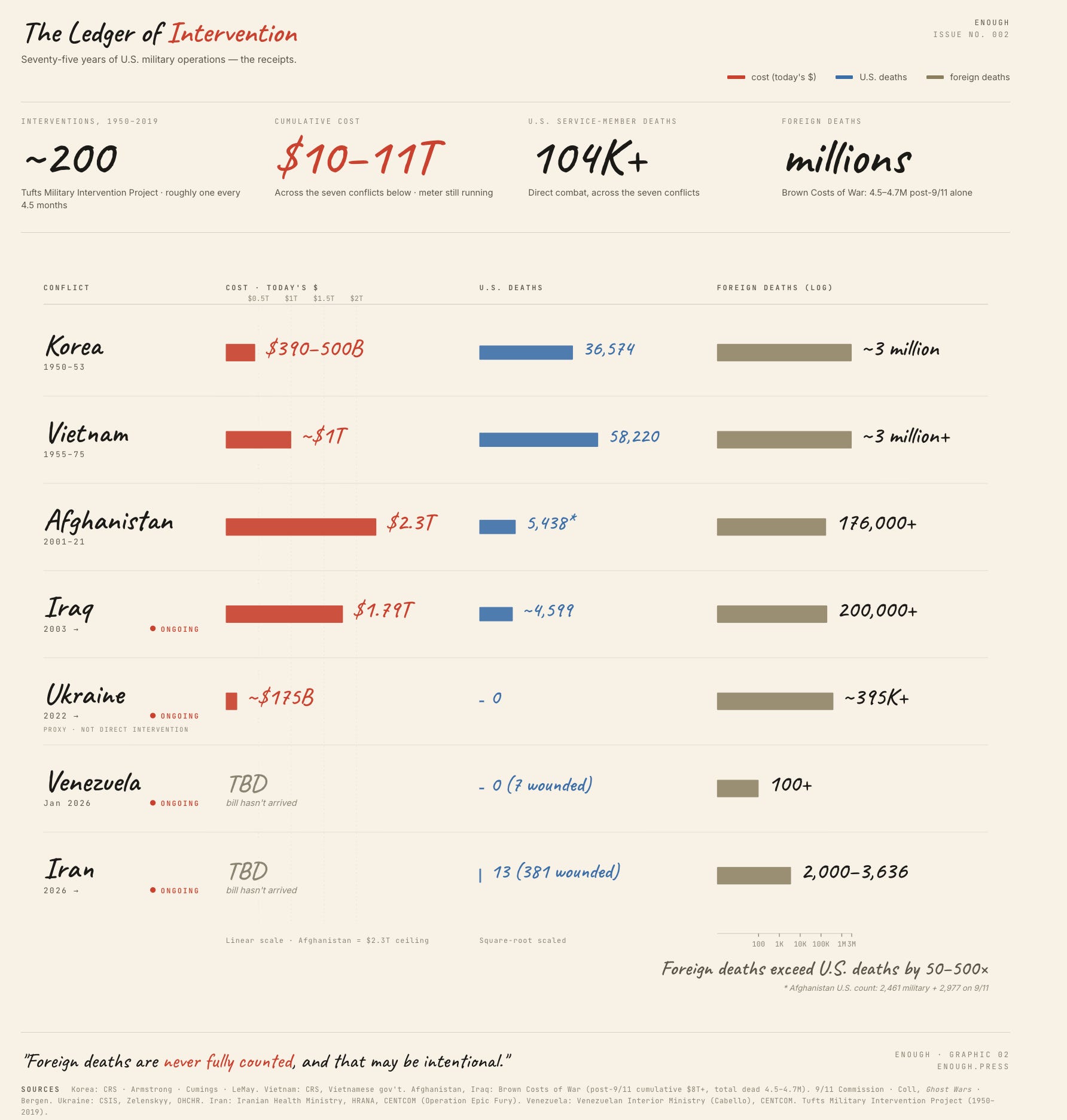
The exasperating question is why.
Why have we been bankrupting our country to enter into wars with countries that pose no direct threat to us?
At horrific cost to our servicemen and women.
To our veterans.
To the countries we have attacked.
To our reputation as a country.
To our own quality of life.
The system: the military-industrial complex
On January 17, 1961, three days before handing the presidency to Kennedy, President Eisenhower gave his farewell address. He warned about the military-industrial complex.
“In the councils of government, we must guard against the acquisition of unwarranted influence, whether sought or unsought, by the military-industrial complex. The potential for the disastrous rise of misplaced power exists and will persist.“
Before he became President Dwight D. Eisenhower, he served as Supreme Commander of the Allied Expeditionary Force during World War II, and later as the first NATO Supreme Allied Commander Europe. Not a pacifist. Not someone ignorant of the realities of war or threats to the United States.
Less quoted but equally important is what he said immediately after: “We must never let the weight of this combination endanger our liberties or democratic processes. We should take nothing for granted.”
His prescription to prevent this disastrous rise of misplaced power?
“Only an alert and knowledgeable citizenry can compel the proper meshing of the huge industrial and military machinery of defense with our peaceful methods and goals, so that security and liberty may prosper together.”
The warning was that our military, and the industry created to support it, would collaborate to perpetuate its existence.
When there’s no war, there’s little demand for ongoing production of weapons, ships, missiles, drones, tanks, planes. When demand decreases, supply must decrease.
Defense contractors would naturally shrink or go out of business.
And the size of the military would naturally shrink.
The fear of loss is a powerful incentive.
The System: The Military Industrial Complex
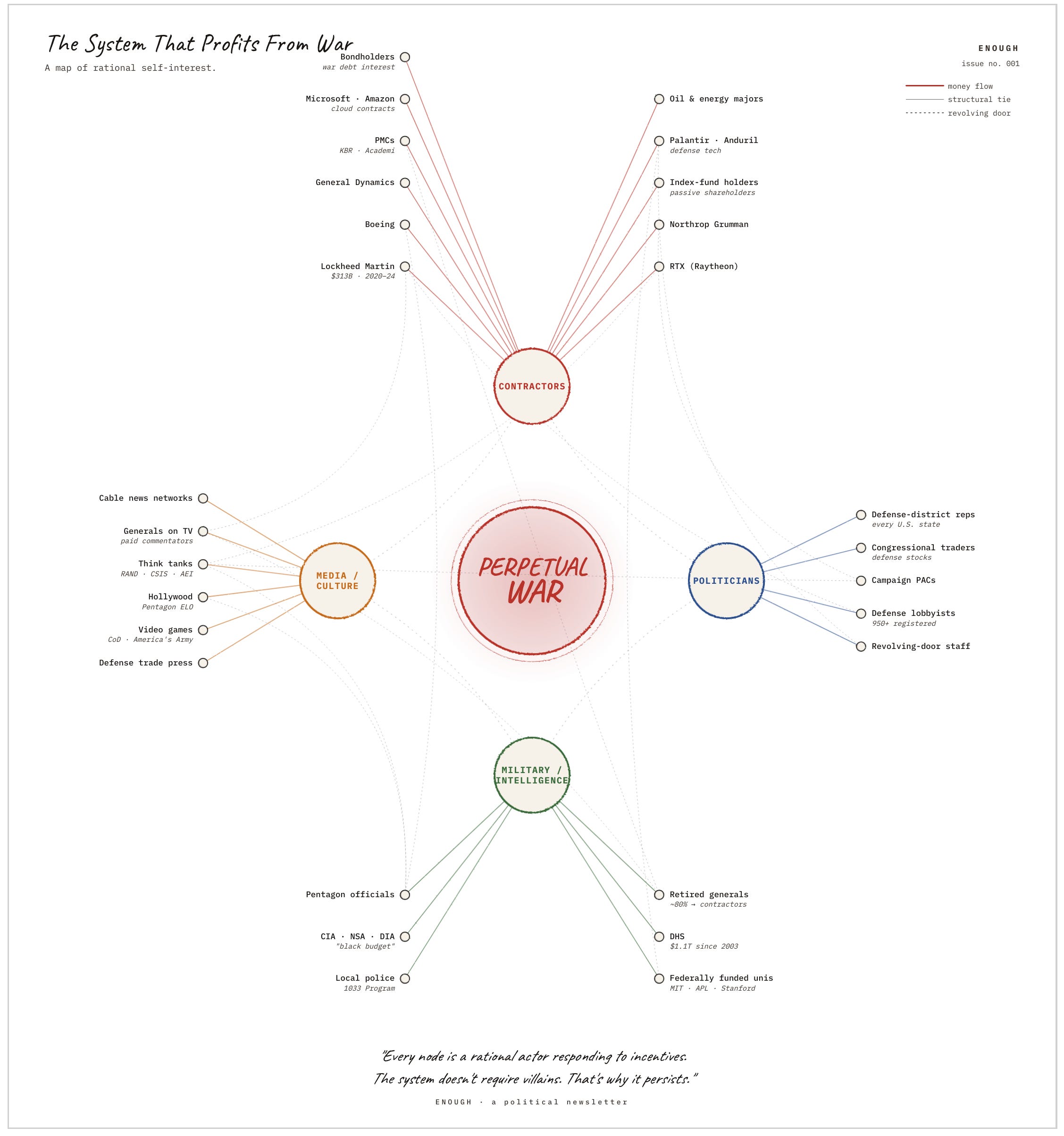
Hang on to your hats. This seems incredibly complex (no pun intended), and the system itself is. But that complexity just serves to obscure a simple and devastating reality. Constant war is very profitable for a very small number of people.
“War is a racket. It always has been. It is possibly the oldest, easily the most profitable, surely the most vicious. It is the only one international in scope. It is the only one in which the profits are reckoned in dollars and the losses in lives.”
Smedley Butler, Marine Corps Major General, two-time Medal of Honor winner
What it is
A system where the companies that make weapons, the politicians who approve weapons budgets, and the generals who buy weapons all benefit financially from war. So they keep making war happen.
How it works
Imagine a three-way handshake.
The companies (Lockheed, RTX, Boeing, Northrop, General Dynamics) make weapons. They need the government to buy those weapons. Without war or the threat of war, nobody buys weapons.
The politicians approve the defense budget and vote on wars. They need money to get reelected. The weapons companies give them campaign donations. The weapons companies also build factories in their districts, creating jobs. So politicians have two reasons to keep defense spending high: money for their campaigns and jobs for their voters.
The generals run the Pentagon and decide what weapons to buy. They also provide threat assessments and shape leadership’s perception of what our policy should be.
When they retire, the weapons companies hire them as consultants and board members, often tripling or quadrupling their income. 81% of four-star officers who retired between June 2018 and July 2023 took jobs in the arms industry. So generals have a financial incentive during their Pentagon career to stay friendly with the companies they’re buying from.
Each of these three groups helps the other two. Money flows in a circle.
Taxpayers → Politicians (who approve the budget)
Politicians → Pentagon (which spends the budget)
Pentagon → Weapons companies (which get the contracts)
Weapons companies → Politicians (via campaign donations and lobbying)
Weapons companies → Generals (via post-retirement jobs)
Back to the start.
Who wins
The short list:
Weapons companies and their shareholders. $771 billion in Pentagon contracts went to just five firms from 2020-2024. Lockheed $313B, RTX $145B, General Dynamics $116B, Boeing $115B, Northrop $81B. Their CEO’s earn an average of $20,000,000 / yr.
Politicians of both parties. Campaign donations, jobs in their districts, and in many cases personal stock trading profits from defense stocks.
Generals and Pentagon officials. Big salaries after they retire, paid by the companies they used to do business with.
Lobbyists. Roughly 950 registered defense industry lobbyists, more than there are members of Congress.
Think tanks and “experts.” Funded by defense contractors to produce the analysis that argues for more military spending.
Cable news networks. Ratings spike during wars. Retired generals paid by defense contractors appear as neutral analysts.
Foreign arms buyers. Allies like Saudi Arabia and Israel buy American weapons. Good business for the contractors.
Who loses
American soldiers. 104,000+ dead since Korea.
Foreign soldiers & civilians. Brown’s Costs of War estimates 905,000 to 940,000 direct deaths and 4.5 to 4.7 million total deaths across post-9/11 war zones when you include indirect deaths from war-caused disease, malnutrition, and infrastructure collapse. Failed states. Humanitarian crises. Tens of millions displaced.
Veterans & Veteran’s families. Brown’s Costs of War puts long-term medical and disability obligations to post-9/11 veterans through 2050 at over $2 trillion. The Pentagon’s $832B in FY2024 outlays does not include this bill. It comes due later, paid by future taxpayers.
Americans - all of us. Ten trillion dollars in foreign wars since 1950. Nearly a trillion borrowed & spent each year. In 2024 we spent $881 billion servicing interest on the national debt, more than the Defense Department’s discretionary budget. We now spend more paying for past wars than fighting current ones.
The State Department, USAID, and the Peace Corps. Every non-military instrument of American influence has been starved while the Pentagon has been fed. The Peace Corps annual budget is around $410 million. The State Department, USAID, and foreign operations combined run about $58 billion. The Pentagon runs nearly $1 trillion. We have built one tool and let the others rust.
The numbers. How to spend a trillion dollars.
We’ve seen the estimated cost of armed conflicts just in this century. That number is in addition to our annual defense spending.
The U.S. spent $997 billion on defense in 2024, nearly 40% of all military spending on earth, more than the next nine countries combined. China, the second-largest spender, came in at $314 billion. Russia spent $149 billion (SIPRI 2024). We outspend China more than 3 to 1, and Russia nearly 7 to 1.
We maintain 750 military bases around the world. UK: 16. France: 11. Russia: ~20. China: 1.
The Pentagon has failed eight consecutive audits.
We’ve spent $2,000,000,000,000 developing a plane (The F-35) that hasn’t met its performance goals over the past five years, and is so expensive to operate, that the solution is to use it less.
Trumps 27’ budget proposes an increase to $1.5 Trillion.
This infuriating waste and inefficiency has been on display during the conflict with Iran
In Operation Epic Fury, Iran retaliated with mass drone attacks. Cheap drones. The Shahed-136 design costs roughly $50,000 to build. Iran fired more than 2,000 of them at U.S. bases and regional targets in the first weeks of the war. We shot a lot of them down. We did it by firing Patriot and THAAD interceptors that cost between $3 million and $12 million each. Every successful intercept was a financial loss. Even pro-war commentators have called the exchange ratio “unsustainable.” Pentagon stockpiles of interceptors are now depleted to the point that the Air Force’s FY2027 budget request includes $1.4 billion in new funding specifically for base defense against drones.
Some of the drones got through. NBC reported in late April that Iranian strikes on Camp Buehring damaged warehouses, hangars, a command headquarters, satellite communications, runways, advanced radar systems, and dozens of aircraft. Repair costs are expected to run into the billions. An Iranian F-5, a fighter platform designed in the late 1950s, also breached the Patriot shield and reached an American base.
The U.S. military deployed Ukrainian-built counter-drone technology, a system called Sky Map, at Prince Sultan Air Base in Saudi Arabia. With Ukrainian trainers. We are paying Ukraine $175 billion to fight Russia, and we are now importing counter-drone capability from them because our own, despite a trillion dollars a year and the F-35, cannot keep up.
The U.S. military fielded a new attack drone in this war, the Low-cost Unmanned Combat Attack System. LUCAS. Built by an Arizona company. It is a reverse-engineered copy of the Iranian Shahed-136. We are now copying Iranian drone designs. Iran built the original on a budget that would not buy us a single Patriot interceptor.
China builds advanced hypersonic systems at a fraction of our per-unit cost. We are losing the efficiency competition while outspending our adversaries 3 to 1. That is not a capability problem. It is a procurement and incentive problem. Exactly what Eisenhower warned us about.
The argument is that we need our network of overseas military bases for security. We don’t. We have alliances like NATO. Instead of destabilizing a country a year, we could focus on diplomacy, strategic support, and the Peace Corps.
One of the great advantages of this country is genuine efficiency and innovation. American ingenuity has historically produced more output per dollar than any comparable nation, in manufacturing, technology, agriculture, medicine. There is no principled reason that advantage should not extend to defense.
The cure
Now we know why. There is a deeply entrenched system of incentives in place. So how do we fix it?
The reforms below are ordered by leverage. Cut off the money first. Reform the process second. Rebuild the alternative third. Audit and accountability fourth. Cultural change last.
1. Prohibit government officials from meeting with registered lobbyists. Companies can hire lobbyists. Industries can fund them. We cannot stop that and shouldn’t try. It would be challenged and killed in court within a year. What we can do is eliminate the demand side. If no elected official, appointed official, or DoD employee is permitted to take a meeting with a registered lobbyist, the entire industry loses its leverage overnight. Enforce it the same way we enforce conflicts of interest. Mandatory disclosure, criminal penalties for violations, and a public registry of all attempted contacts.
2. Restore the constitutional requirement for congressional war declarations. Require a formal declaration of war from Congress before any military deployment, with statutory criminal penalties for executive circumvention. No more wars authorized by vague resolutions that politicians can later disavow. No declaration, no deployment. Full stop.
3. End the revolving door, permanently. Ban senior Pentagon officials from joining defense contractors.Require disgorgement of compensation for violations. Make it a real prohibition with real criminal consequences.
4. Right-size the defense budget. Three line items. (a) Justify every overseas military base. The U.S. operates roughly 750 military installations in 80 countries, more than every other nation combined. Most are legacy footprints from conflicts that ended decades ago. Require affirmative, recurring justification for every single one against a documented threat. Any base that cannot pass that test, close it. The savings fund the transition for the workers and communities affected. (b) Pass the Audit the Pentagon Act with the 1% penalty. Senator Sanders and Senator Grassley have introduced legislation requiring any DoD component that fails a clean audit to return 1% of its budget to the Treasury. The amendment has not received a roll call vote. After eight straight failed audits, it should. An institution that cannot account for its F-35 spares pool does not get to self-certify a $1 trillion budget. (c) End cost-plus contracts as the default. Cost-plus is a procurement structure where the contractor is reimbursed for whatever the project costs, plus a fee on top. The contractor’s incentive is for the project to cost more, because more cost can mean more profit. Cost-plus has a defensible role in genuinely uncertain R&D where fixed-price is impossible. It does not have a defensible role as the default for production weapons systems, which is what it has become. Replace it with fixed-price contracts and competitive bidding wherever the work is well-defined enough to allow it. The companies that cannot deliver under those terms are the companies you do not want building your weapons.
5. Define intervention criteria by statute. Military force is authorized only when (a) there is a direct, documented threat to American soil or citizens, (b) Congress has issued a formal declaration of war, or (c) a specific multilateral treaty obligation has been triggered. Nation-building, regime change, and ideological projection are not criteria. Every overseas military installation requires affirmative, recurring justification under these standards.
6. Double the State Department budget. The current military-to-diplomacy spending ratio is roughly $15 to $1. Double the State + USAID + foreign operations budget from $58 billion to $116 billion within four years, funded by eliminating weapons programs that have failed their performance reviews. Diplomacy is cheaper than war by several orders of magnitude.
7. Require sunset clauses on all sanctions regimes. Every sanctions program requires a formal effectiveness review every three years. If it is not working, it expires. The Cuba embargo has run more than 60 years. GAO has confirmed Treasury, State, and Commerce do not conduct their own assessments of overall effectiveness of existing sanctions programs in achieving broad policy goals. That is not policy. That is inertia.
8. Restore the CIA to intelligence gathering. Full stop. The CIA’s original mandate was collection and analysis. Covert operations and regime change have produced some of the most catastrophic blowback in American history. Iran 1953. Guatemala 1954. Chile 1973. Afghanistan in the 1980s.
9. Create a national service abroad program. Two years of international civilian service through an expanded Peace Corps or AmeriCorps earns fully funded college. Language immersion. Community development. Infrastructure. Public health. The Peace Corps annual budget is around $410 million. The F-35 program’s lifecycle cost for the planned U.S. fleet exceeds $2 trillion (GAO, 2025). A generation of Americans who have lived abroad, speak a second language, and built real relationships in developing nations is a more effective foreign policy instrument than any weapons system. Soft power is real power.
The trade-offs.
Right-sizing the defense budget means contraction in the defense industry. Job losses in communities built around defense manufacturing. These are real people who didn’t design the system they work inside.
The answer is not to preserve a broken system to protect those jobs. The answer is to plan the transition. The workers who build missiles have the skills to build high-speed rail, grid infrastructure, and domestic semiconductor manufacturing, if the contracts exist. Post-World War II, the United States converted its entire defense manufacturing base to civilian production and fueled the largest economic expansion in American history. We have done this before.
Some will argue that restraint signals weakness to adversaries. The historical record suggests the opposite. Decisive, proportional response to actual threats is not weakness. It is the definition of strategic strength.
Speak softly and carry a big stick. - Teddy Roosevelt
The world’s perception of the United States is at a historic low. Our adversaries are better funded relative to output, more strategically patient, and less encumbered by a defense industry that has captured its own government.
Insanity is doing the same thing over and over and expecting a different result.
We have 75 years of hard data. Korea. Vietnam. Iran. Iraq. Afghanistan… The pattern is not bad luck. It is the system working exactly as designed, for the people it was designed to serve.
It is long past time to try something different.
A strong America fights when it must, wins when it fights, and invests the difference in the things that actually make a country worth defending. Infrastructure. Education. Healthcare. Economic security. And a government its citizens trust.
The military-industrial complex is not necessarily about evil people wanting war. It is about ordinary people making rational choices inside a system that rewards war and punishes peace.
Fix the incentives and you fix the system. Leave the incentives alone and no election, no protest, and no president will change the outcome.
Subscribe. If you want a publication that won’t pull punches in either direction, this is yours.
Share. Forward this to one person who’s had enough.
Reply. What did this miss? Hit reply. I read everything.
And if you can, become a paid subscriber. This will always be free, but I would love to expand the reach.
Recommended reading
On Iran and U.S. policy:
Trita Parsi, Treacherous Alliance: The Secret Dealings of Israel, Iran, and the United States (Yale University Press, 2007). The definitive account of the 2003 Grand Bargain and the broader trilateral dynamic.
Stephen Kinzer, All the Shah’s Men: An American Coup and the Roots of Middle East Terror (Wiley, 2003). The 1953 coup, narrative-driven and accessible.
Flynt Leverett and Hillary Mann Leverett, Going to Tehran: Why America Must Accept the Islamic Republic of Iran (Metropolitan, 2013). Two former NSC Iran officials make the case that the entire diplomatic posture is wrong.
Ervand Abrahamian, Iran Between Two Revolutions (Princeton, 1982). The standard scholarly history of 20th-century Iran.
On the military-industrial complex:
James Ledbetter, Unwarranted Influence: Dwight D. Eisenhower and the Military-Industrial Complex (Yale, 2011). The archival history of the farewell address and what came after.
Andrew Cockburn, The Spoils of War: Power, Profit and the American War Machine (Verso, 2021). How the system actually works, from procurement to lobbying to retired generals.
Smedley Butler, War Is a Racket (1935). Twenty thousand words. Read it in one sitting.
On Afghanistan and post-9/11 wars:
Steve Coll, Ghost Wars: The Secret History of the CIA, Afghanistan, and Bin Laden (Penguin, 2004). Pulitzer Prize. The definitive account of Operation Cyclone and what it built.
Brown University Watson Institute, Costs of War project (costsofwar.watson.brown.edu). Continuously updated, the best single source for the human and financial cost of post-9/11 wars.
On Iraq’s chemical weapons program and U.S. complicity:
Joost Hiltermann, A Poisonous Affair: America, Iraq, and the Gassing of Halabja (Cambridge, 2007).
Documentary:
Eugene Jarecki, Why We Fight (2005). Eisenhower’s warning, fifty years later.
Sources: Brown University Costs of War Project · Congressional Research Service · Council on Foreign Relations · Center for Public Integrity · U.S. Department of Defense (DCAS) · SIPRI 2024 · Quincy Institute for Responsible Statecraft · Pew Research Center · National Security Archive at GWU · GAO · UN OHCHR · CSIS · Vietnamese government casualty estimates · Trita Parsi, Treacherous Alliance (Yale, 2007) · Steve Coll, Ghost Wars · James Ledbetter, Unwarranted Influence (Yale, 2011) · Joost Hiltermann, A Poisonous Affair (Cambridge, 2007).